Email : zhou@sinobiochemistry.com Phone : +86-13941198570


Views: 0 Author: Site Editor Publish Time: 2026-01-23 Origin: Site


Antimony Trioxide (ATO) is a versatile inorganic compound valued for its unique properties, particularly as a flame retardant and synergist. Below is a detailed overview of its primary application sectors and technical benefits for industry professionals:
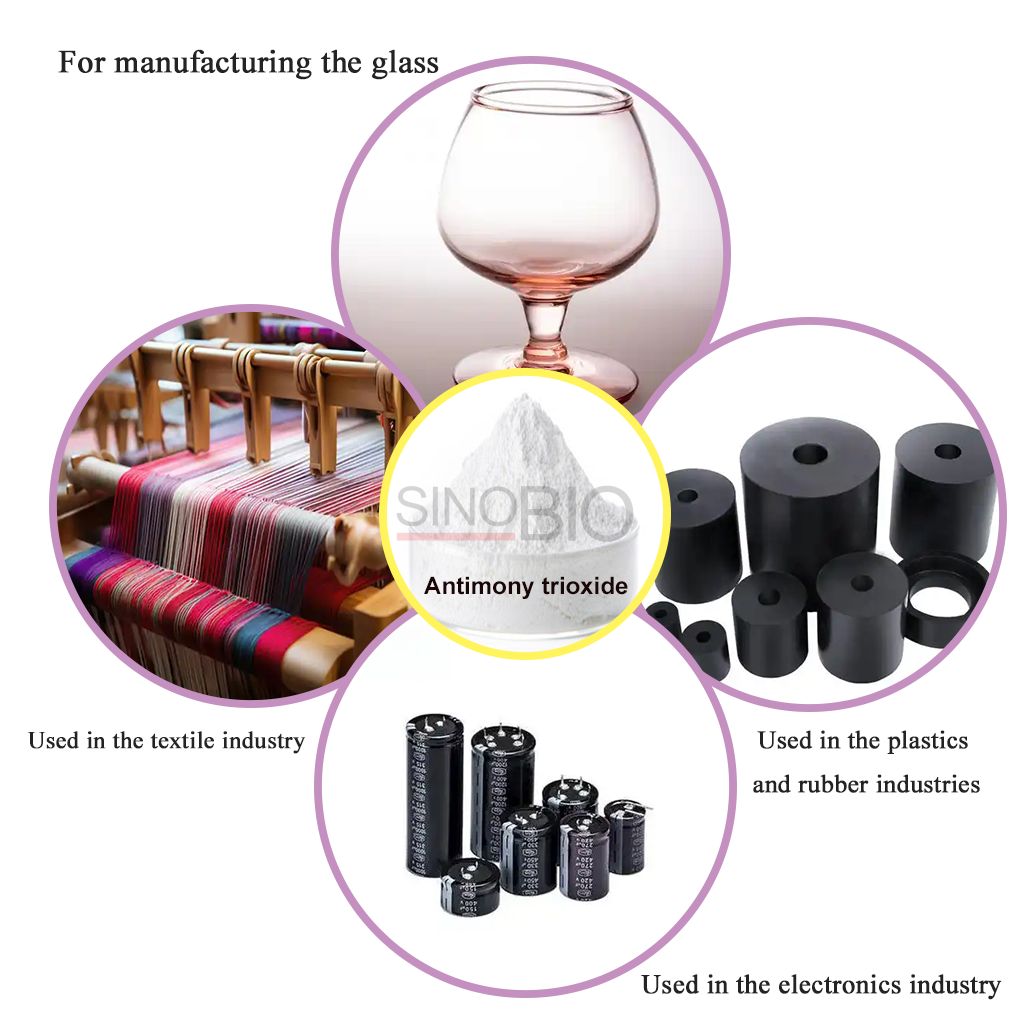
ATO is a critical flame retardant (FR) additive, widely used in thermoplastics and thermosets due to its excellent synergistic effect with halogenated compounds. When combined with brominated or chlorinated FRs, it significantly enhances flame suppression efficiency by releasing antimony halides that interrupt the combustion chain reaction.
Used in wires, cables, and building materials (e.g., pipes, profiles) to meet UL94 V0/V2 flammability standards. Typical addition levels range from 3-8 phr.
Applied in ABS, PBT, and PP for automotive components (interior parts, connectors) and electronic housings, reducing smoke emission during combustion.
In glass manufacturing, ATO serves dual roles as a decolorizing agent and opacifier. It neutralizes the green tint caused by iron impurities (Fe²⁺) by oxidizing them to Fe³⁺, improving glass clarity. In ceramics, it is used in glazes and enamels to create opaque finishes and enhance chemical resistance.
ATO is essential in electronic materials for fire safety compliance:
Added to laminates to achieve flame retardancy ratings required by IEC 60335 and UL 746C.
Used in epoxy resins for transformer insulation and capacitor coatings, ensuring thermal stability at high temperatures.
Acts as a catalyst in the production of polyethylene terephthalate (PET) and in the oxidation of hydrocarbons.
Used in white pigments for paints and inks, as well as in protective coatings for metal surfaces to prevent corrosion.
Applied in flame-retardant finishes for industrial textiles (e.g., conveyor belts, fire curtains) used in high-risk environments.
Technical Note: The performance of ATO varies by particle size and purity. High-purity grades (≥99.5%) are recommended for electronic and pharmaceutical applications, while standard grades are suitable for general polymer processing. For technical specifications, sample requests, or application-specific recommendations, please contact our technical support team at zhou@sinobiochemistry.com


